
The Situation

A packaging and printing manufacturer — 300M+ RMB in annual revenue, 2,000+ SKUs, serving FMCG and electronics clients — came to us with a problem they'd been living with for years.
Their entire production schedule lived in the heads of two senior planners. When those planners were on vacation or sick, the replacement team members made scheduling errors averaging 30-40%. Rush orders were handled by "guessing and hoping." Cost estimates for new bids were based on rough rules of thumb, which meant the company either lost profitable bids or accepted work at negative margins.
The CEO put it bluntly: "If either of our two planners quits tomorrow, we don't know how we'll run the factory."
This is not an unusual story. In many mid-sized manufacturers, the most valuable process knowledge exists only in the minds of a few people. And when those people leave — or even just take a day off — the business suffers.
What We Found During the Data Audit
We started where we always start: with the data. The client shared 14 months of historical work order records from their ERP system. After our initial data cleaning (quartile-based outlier removal plus Isolation Forest to drop clearly bad samples), we had a training set of roughly 8,000 completed work orders.
Each record contained:
- Order metadata: SKU, quantity, deadline, customer tier
- Process details: machine assignment, operator, material type, complexity score
- Actual outcomes: start time, end time, quality inspection results, rework events
Three patterns emerged immediately:
1. The planners were good — but inconsistent. On a normal day, their schedules were within 10-15% of optimal. On busy days, during holidays, or when covering for each other, errors ballooned to 30-40%.
2. Certain SKU-process combinations were systematically misestimated. A specific category of custom gift boxes was consistently under-estimated by 20-30% because planners applied a generic "box" template to what was actually a complex multi-process order.
3. Quality anomalies had predictable precursors. When certain material-parameter combinations appeared together, the probability of a quality issue jumped 3-5x. But this was only visible in hindsight — nobody was monitoring it in real time.
What We Built

A Private Labor-Time Prediction Model
We trained a gradient boosting model (XGBoost) on the 14-month work order history. The model takes a new order's features — SKU complexity, material type, current line load, operator skill level — and predicts the expected processing time with a confidence interval.
Key design decisions:
- On-premise deployment: The model runs as a FastAPI endpoint on the client's own server. No data ever leaves the factory. The client owns the weights, the data, and the API.
- Monthly retraining: Every month, the model retrains on the latest 3 months of data. This ensures it adapts to changing conditions — new equipment, new SKUs, seasonal shifts.
- Seamless integration: Rather than replacing the planners' existing tool, we embedded the model as an API call within their workflow. Planners still make the final call, but they now have a data-backed baseline instead of guessing.
Quality Anomaly Early Warning
We built a second model focused on quality prediction. By analyzing historical defect records alongside process parameters, we identified the parameter combinations most likely to lead to quality issues.
The system monitors production in real time and sends alerts when the anomaly probability crosses a threshold. This means the team can intervene before hundreds of units are produced with a defect — catching problems at 50 units instead of 500.
Smart Cost Estimation
The labor-time predictions feed into a cost estimation module that fuses predicted工时 with material costs, equipment depreciation, and energy data. For any new order, the sales team gets a cost range within 10 seconds — replacing the old "experienced guess" approach.
The Implementation Timeline

Month 1-2: Data Foundation
We cleaned 14 months of ERP data, established baselines for labor time, quality, and cost metrics, and defined the training set.
Month 3-4: Model Deployment
The labor-time prediction model was trained, validated, and deployed as a FastAPI endpoint. The quality alerting module went live simultaneously. Planners began using the system alongside their existing process.
Month 5-6: Cost Estimation and Optimization
The cost estimation module launched. The model retraining pipeline was automated. We ran a factory-wide OEE improvement program using the new data visibility.
The Results
| Metric | Before | After |
|---|---|---|
| Daily planning time | 4 hours | 2.5 hours (-50%) |
| On-time delivery rate | 78% | 94% |
| Schedule error (planner absent) | 30-40% | <10% |
| Incoming defect rate | baseline | -42% |
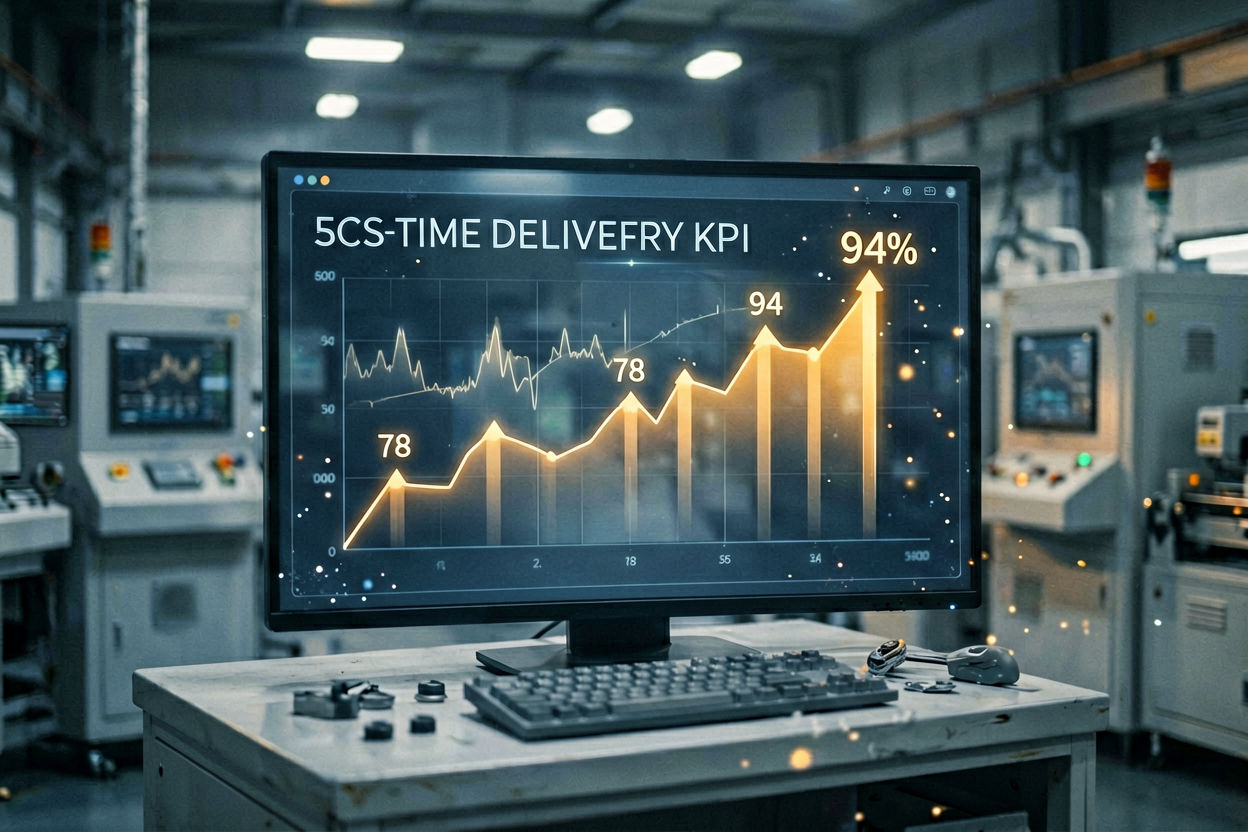
But the most important result doesn't show up in a table: the factory is no longer dependent on two individuals. The knowledge that lived in their heads is now encoded in a model that runs every day, retrains every month, and gets smarter with every new work order.
What This Means for Your Business

If your production scheduling, cost estimation, or quality control depends heavily on a few key people, the same approach can work for you. The requirements are simple:
- At least 3 months of historical work order data (the more, the better)
- Willingness to share a representative sample for the initial audit
- A production environment where the model can run on-premise
Most projects ship an analysis report within 7 days. A production-deployed model typically takes 4-6 weeks from kickoff.
Your data is your competitive advantage. The model trained on it is uniquely yours — nobody else can replicate it, because nobody else has your data. That's the moat.