
The Two Bottlenecks Nobody Calls "Bottlenecks"
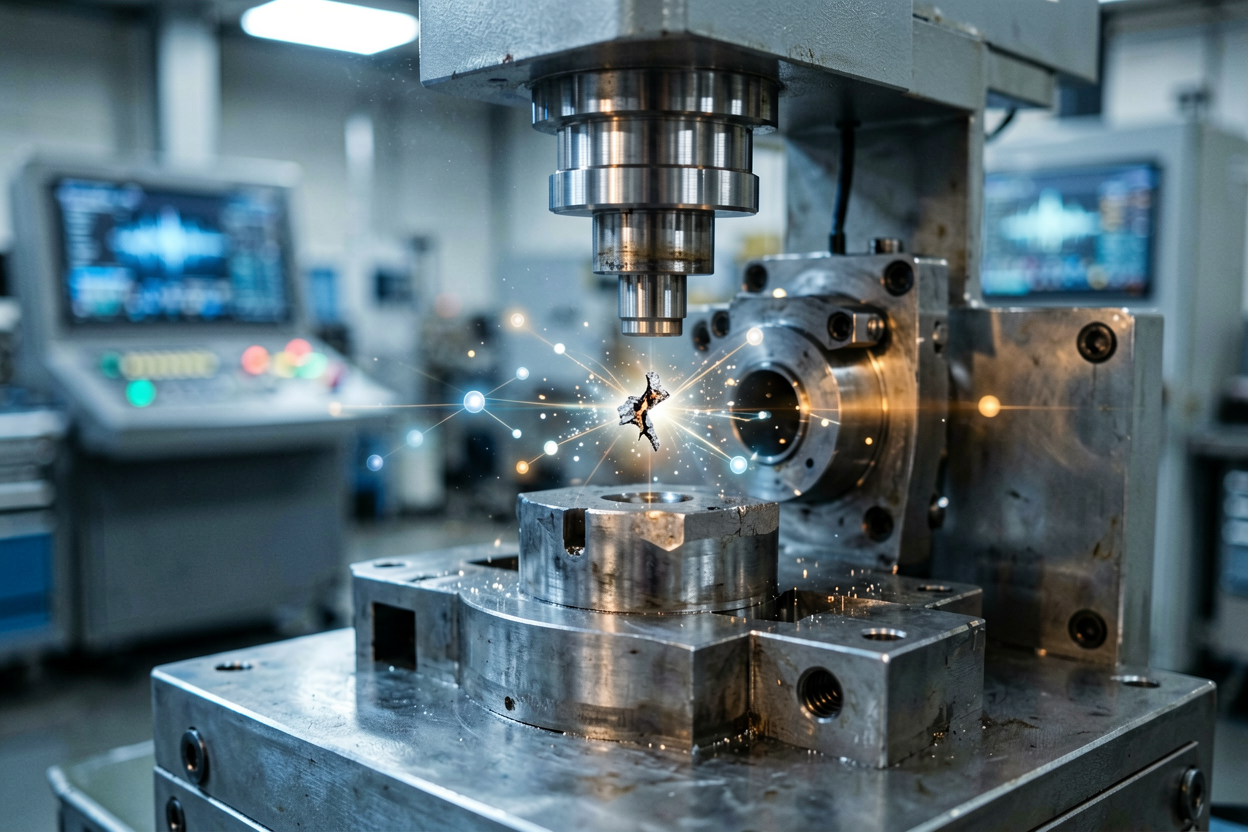
Walk into most hardware processing shops and you will hear about throughput, OEE, and on-time delivery. Spend a day on the floor and the real constraints surface quickly: defect detection and changeover setup. They rarely show up as cleanly named KPIs, but they quietly tax every shift.
One shop we worked with ran 8-12 changeovers a day across precision stamping and CNC parts. Setup times were longer than the runs themselves for low-volume SKUs. Defects were caught at end-of-line inspection — sometimes minutes, sometimes hours after they happened. New hires took six months to work independently because every "right way" to set up a job lived in someone else's head.
The team was not underperforming. The processes had simply outgrown the people-capacity that supported them. We rebuilt both bottlenecks on a private-AI foundation the shop could own.
Defect Detection That Catches Failures at Fifty, Not Five Hundred
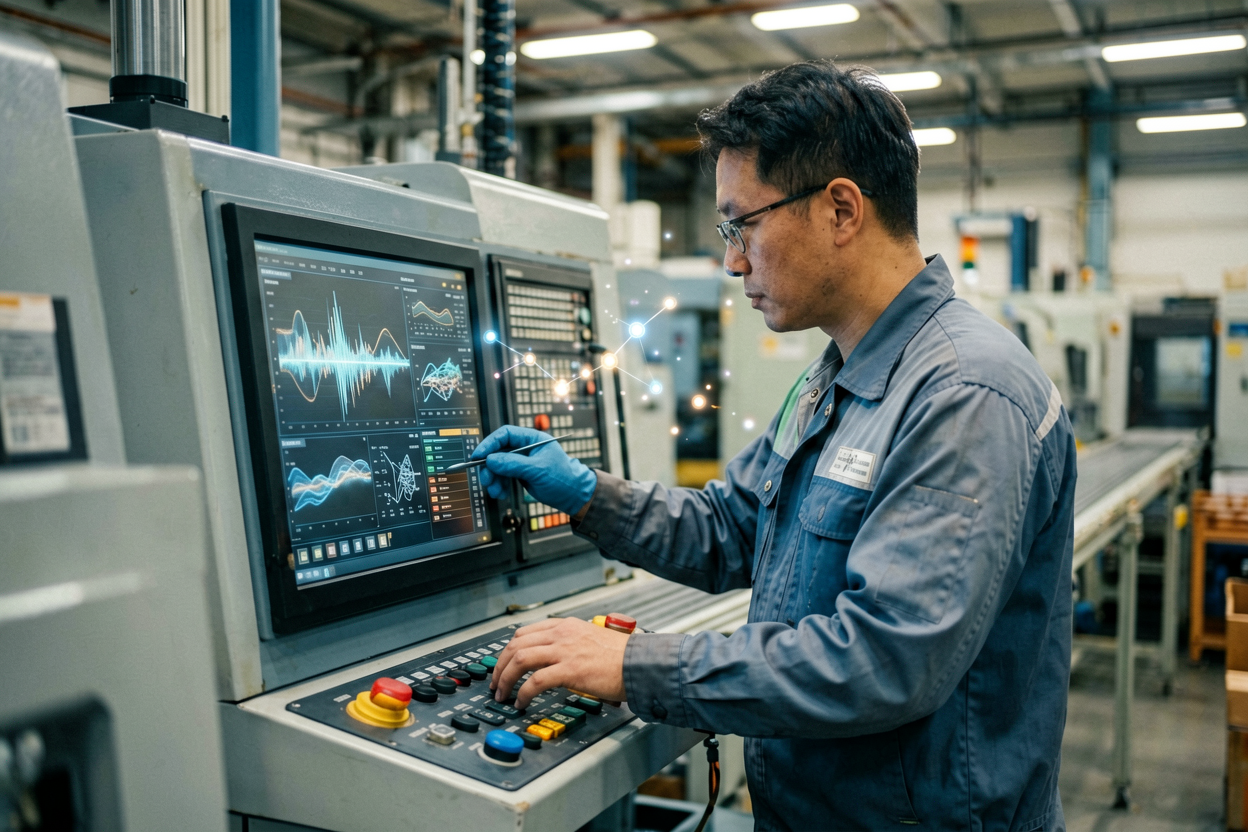
The classic approach — a fixed camera at the end of the line inspecting finished parts — has a structural blind spot. By the time a defect is visible at end-of-line, hundreds of units have already been produced with the same root cause.
We rebuilt defect detection around process signatures rather than finished-part inspection. The model sits on top of the machine's existing sensor stream — spindle current, vibration amplitude, feed-rate deviations — and learns the parameter combinations that historically preceded a defect. When a current run drifts into that envelope, we alert the operator before the next 50 units come off the line.
Practical implications for the floor:
- The model runs on a local edge box next to the machine. No video frames leave the shop.
- Operator retains final say: alerts are suggestions, not stop signals. Acceptance rates climbed from 30% in week one to >85% by month three.
- Drift detection automatically flags when a process changes — new tool, new material, new operator — and the model retrains on the new baseline within 48 hours.
For the AI defect detection manufacturing buyer, this is the architectural difference that matters: the shop keeps the data, the model weights, and the integration. Vendor lock-in is structurally impossible.
Changeover Setup Driven by the Last 1,000 Jobs
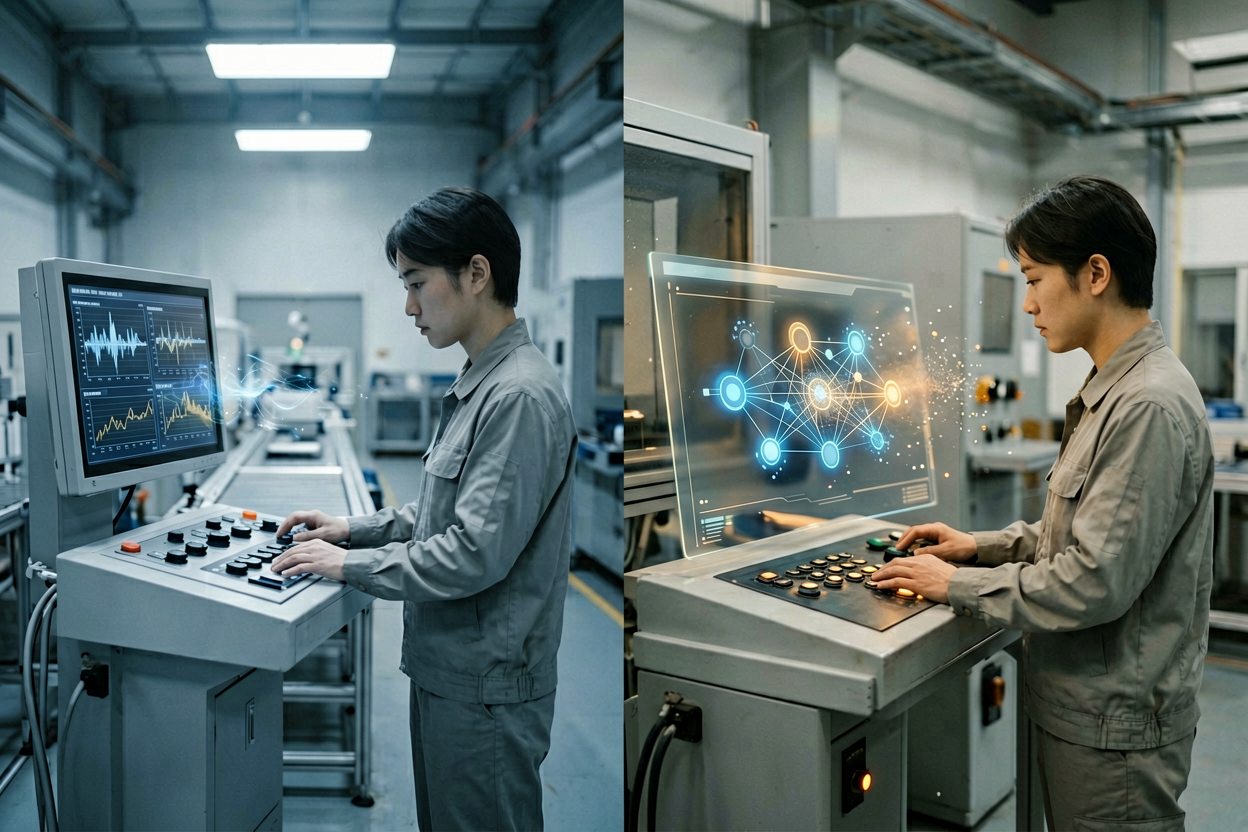
Setup time is usually fought with checklists. Checklists help but plateau quickly. The next leap comes from looking at the last thousand changeovers in the same machine class and finding what actually correlated with the fast ones.
We trained a changeover recommendation model on 12 months of setup logs. Inputs:
- Job pair: the previous SKU and the next SKU being scheduled on the same machine.
- Fixture and tooling state: what was still on the machine from the previous job versus what had to be swapped.
- Operator experience: years on this machine class, recency on this fixture type.
- Time of day and shift: useful covariate; first-shift changeovers were systematically faster than second-shift regardless of operator.
For every new changeover request, the model returns a ranked set of candidate setups with predicted setup times. Planners and operators pick the one that matches the current fixture availability. In practice, the median setup time fell by 18% across the first 30 days, and the variance between the fastest and slowest operator shrank by half.
That is the AI changeover optimization outcome most teams underestimate: it does not just cut average time, it compresses the long tail where new hires and second shifts live.
Knowledge Capture as a Side Effect
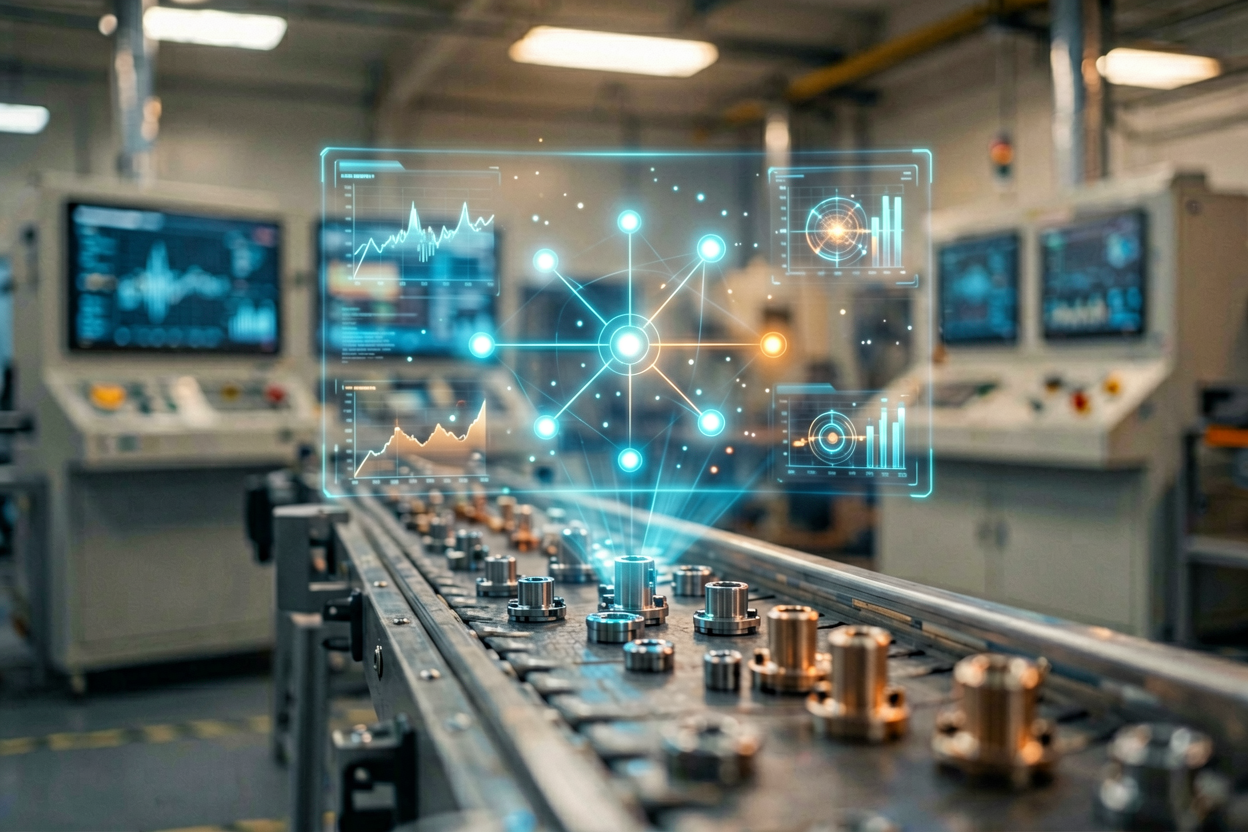
The deeper win — and the one the client board eventually cared about most — was tacit knowledge capture. Every model output is, by construction, a distillation of patterns across many operators. When the model retraining pipeline ingests this week's data, the new hires' good decisions feed future models too.
We measure this with one simple cohort metric: how long until a new hire performs within 10% of a 5-year operator? Before the model, the answer was six months. After, the answer is under eight weeks — a 67% reduction in ramp-up time.
For a shop where the senior operators' retirement risk is a board-level concern, this metric alone can justify the engagement.
What a Private-AI Shop Floor Deployment Looks Like

The deployment in this shop followed a standard shape we now repeat:
Week 1-2: Data audit. Pull sensor logs, MES records, and operator notes. Quartile-based outlier removal plus an Isolation Forest pass drops clearly bad samples. We end up with a defensible training set and a written baseline report.
Week 3-6: Model training and validation. Train the defect and changeover models. Validate against the last 90 days of held-out data. Publish a calibration report the operations team can argue with — and they always argue with it; that is the point.
Week 7-8: Edge deployment. Stand up the runtime on a small GPU-capable box in the plant. Wire it into the MES via a single FastAPI endpoint. Operator-facing dashboard lives inside the existing MES screen, not a separate tab nobody opens.
Week 9-12: Continuous optimization. Monthly retraining. Drift alerts. Quarterly review of which model outputs are still being acted on. Anything that is not acted on gets retired, even if its accuracy is high.
Total: a production-deployed private-AI stack on a hardware processing shop floor in about three months.
When This Pattern Does Not Transfer
Be honest about what does not transfer:
- Single-machine cells. If a shop has one CNC and 50 SKUs per year, the data volume is not enough to train a useful changeover model. The pattern needs at least 1,000 historical changeovers per machine class.
- Visual-only defects that cannot be predicted from process telemetry. If a defect is purely a surface-finish issue visible only under magnification, you need an imaging model alongside the telemetry model — not instead of it. We layer them when the use case justifies the cost.
- Regulated inspection checkpoints. Some industries require that a human inspect every unit. We treat the AI as a quality-of-life tool for operators in those cases — flagging the highest-risk units for closer attention, never replacing the human eye.
The Bottom Line
AI defect detection manufacturing and AI changeover optimization are not separate problems. They are two expressions of the same underlying issue: a process that has outgrown the volume of tacit knowledge a small team can carry. A private-AI deployment — on the shop's own hardware, on the shop's own data — collapses both bottlenecks at once and pays for itself in setup time, ramp-up time, and the value of institutional knowledge that no longer walks out the door at retirement.